
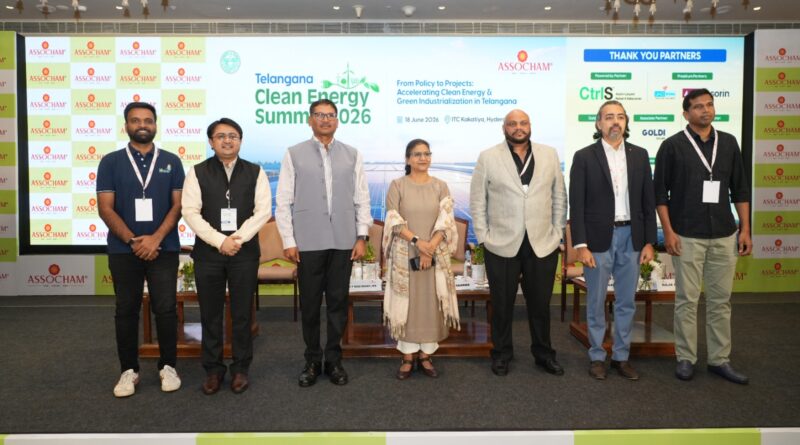
Expert Panels Deliberate on Clean Energy, E-Mobility and Industrial Decarbonization at ASSOCHAM Telangana Clean Energy Summit 2026
Hyderabad, 18th June 2026 : At the ASSOCHAM Telangana Clean Energy Summit 2026 , experts from government, industry, research institutions, public transport, renewable energy, data centres, climate finance, and clean technology sectors discussed the pathways for accelerating Telangana’s clean energy and sustainable mobility transition.
Speaking during the panel on Electric Vehicles and Clean Mobility Transition, Sri Y. Nagi Reddy, IPS, Vice Chairman & Managing Director, TGSRTC , highlighted the corporation’s ambitious bus electrification roadmap and its efforts to build a comprehensive e-mobility ecosystem. He noted that TGSRTC currently operates over 1,050 electric buses and is expanding depot charging infrastructure and electric bus deployment across Telangana. He also emphasized TGSRTC’s vision of achieving 100% green public transport in the CURE region by 2028 and highlighted the corporation’s pioneering efforts in converting diesel buses into electric buses.
In the session on Renewable Energy, Grid Resilience, and Powering Data Centers, Smt. Anila Vavilla, Vice Chairman & Managing Director, TGREDCO , outlined Telangana’s initiatives to accelerate the energy transition through decentralized renewable energy systems, battery energy storage deployment, and expansion of EV charging infrastructure. The discussion highlighted the growing importance of renewable energy integration, grid modernization, and storage solutions in supporting industrial growth, electric mobility, and the rapidly expanding data centre ecosystem.
Moderating the renewable energy panel, Prof. Rajkiran V. Bilolikar, Director, Centre for Energy Studies (CES), Administrative Staff College of India (ASCI), emphasized the need for stronger grid resilience, energy storage systems, and reliable power infrastructure to support India’s evolving energy landscape and emerging sectors such as electric mobility, artificial intelligence, and digital infrastructure.
The summit also featured discussions involving stakeholders from the solar energy sector, data centres, energy storage companies, clean mobility enterprises, future fuels, climate technology startups, carbon capture, utilization and storage (CCUS), carbon market participants, sustainability-focused industries, and financial institutions including SBI. The deliberations highlighted the importance of innovation, investment, policy support, and industry-government collaboration in advancing Telangana’s clean energy and green industrialization agenda.
The summit concluded with a shared view that integrated action across energy, mobility, manufacturing, finance, and technology will be critical to position Telangana as a leading hub for clean energy, sustainable infrastructure, clean mobility and low-carbon economic growth.
